© 200● The Institute of Electrical Engineers of Japan. 1
Paper, Technical Note の作成見本
付録2248 mm60行
16 mm 16 mm
1行あ
図を入 た 行 余白
本文を流 さ い
1行あ 8 mm
あ 25 mm
本文 9 イン
また 13
式 始ま 2字分さ 2行分
178 mm
1字さ
左右中央 書く
用 サイズ A4 設定す
1行あ 1行あ
左右中央 書く
1行 2名ま 横 並べ 記入可。 3名以 改行し 記入。 3行あ
17 イン また 24
原稿 種別
Paper, Technical Note, Letter を書く
13 イン また 18 1行あ
左右
2字分あ
2行分 1字さ
10 イン また 14
オモテケイ
85ミ
2字あ
24 mm
図 説明 左右2字分あ , 中央 書く
8.5 イン また
12
1行あ
10 イン また 13
8.5 イン また 12
注:1字あ い 2字さ ,日本語文字 1字分あ い 2字分 相当 し さい。
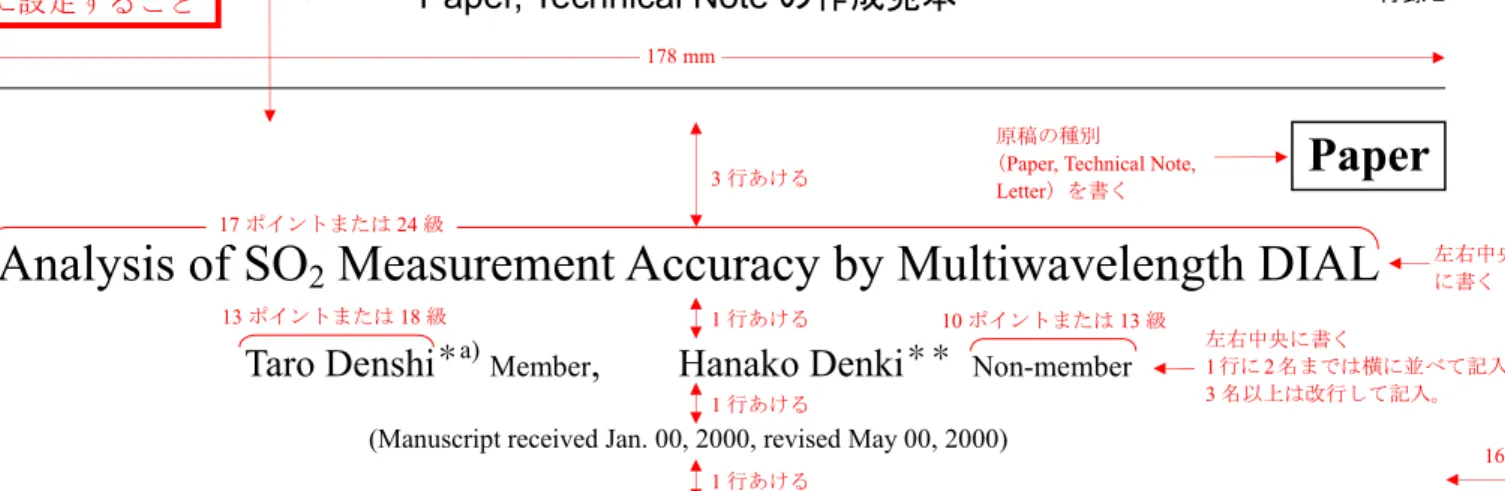
Analysis of SO 2 Measurement Accuracy by Multiwavelength DIAL
Taro Denshi
a)Member, Hanako Denki
Non-member (Manuscript received Jan. 00, 2000, revised May 00, 2000)This paper presents two multiwavelength methods to improve the accuracy of a DIAL system for measuring SO2 in the lower atmosphere: a dual-DIAL method using three or four wavelengths, and a curvefitting method using five wavelengths. By the selection of appropriate wavelengths, these methods can eliminate the effects of ozone and aerosols. Since there is no significant difference in accuracy between the four wavelength dual-DIAL and curvefit methods, the former is advantageous for SO2 detection in view of the measurement and data processing speeds.
Keywords : laser radar, SO2, DIAL, multiwavelength differential absorption
1. Introduction
LIDAR (LIght Detection And Ranging) has been used for measurement of atmospheric pollutants by Raman scattering, resonant fluorescence, and differential absorption(1). Fig. 1 is a schematic diagram of a LIDAR system. This apparatus transmits laser radiation into the atmosphere, collects light backscattered by atmospheric molecules and particulates using a receiving telescope, and converts it to an electric signal using a photodetector such as a photomultiplier tube. The measurement height is obtained from the time delay between illumination and detection. Therefore, to measure the height profile one measures the received photon counts as a function of time delay relative to illumination using a multichannel scaler. The measurement range resolution ∆R is determined by the time width of the channel ∆t=2∆R/c, where c is the speed of light. The smaller the time ∆t, the better the range resolution, but the photon count per channel becomes less and the relative error larger.
This paper examines DIAL (DIfferential Absorption Lidar), a method to obtain the concentration profile of the measurement target molecule from the backscatter intensity at two or more illumination wavelengths. The measurement target is atmospheric SO2, which is a substance causing acid rain. Until now, measurements of atmospheric SO2 have been limited mainly to cases of localized SO2 concentrations, e.g. smokestack exhaust and volcanic eruptions(2)-(4). In these cases, the SO2 concentration is over 100 ppb, therefore the measurement was relatively easy and the measurement accuracy was not a problem. However, when measuring SO2 in the ambient atmosphere, its concentration is of ppb order, and the measurement accuracy becomes an issue. We performed a theoretical analysis of the measurement accuracy of conventional two-wavelength DIAL, and indicated the necessity of elimminating effects due to ozone
and other substances which cause measurement error(5). In this paper, we examined the measurement accuracy of dual-DIAL methods using three or four wavelengths (consisting of a combination of two two-wavelength DIAL pairs) and a curvefit method using five wavelengths.
2. Multiwavelength Differential Absorption
2.1 Fundamentals of DIAL The received energy for a LIDAR is given by the following LIDAR equation:
[
0]
2 0 0( , ) ( ) exp 2 R( )
r i x
E R E A R R dR
R π
λ = η ∆ β × −
∫
α α+ ′ ... (1) Here Er(R,λi) is the backscattered photon energy received from range between R and R+∆R from the illumination laser, λi the illumination wavelength, E0 the illumination energy, η the optical efficiency of the4. Conclusion
In this paper, we calculated the error due to ozone and aerosols in measurement of SO2 concentrations of ppb order using DIAL. The statistical error of the return signal and background noise can This paper is based on “Analysis of SO2 Measurement Accuracy
by Multiwavelength DIAL” published in XXXX Research Report, No.XX (2012-3)
a) Correspondence to: Taro Denshi. E-mail: taro@denshi.ac.jp Technical Research Labs., Shin-nichi Electric Co., Ltd.
7-2, Gobancho, Chiyoda-ku, Tokyo 102-0076, Japan Technical Labs., Kagoshima Electron Corp.
2-100, Daikan-cho, Kagoshima 890-0099, Japan
Paper
Fig. 1. Schematic diagram of a LIDAR system.
2 IEEJ Trans. ●●, Vol.●●, No.●, ●●● 1行あ
1行あ 9 イン また 13
ー 表 説明 左右2字分あ ,中央 書く
22 mm 28 mm 2段通し 表 左右165 mm以内
1段 き 左右75 mm以内
表中 7 イン また 10
謝辞を記載 す 場合 , 本文 最後, 文献 前 挿入す 。
付録を付 場合 , 文献 後, 著者紹介 前 挿入す
。
1行あ
be overcome by improving the system constant (laser output, receiver area, optical efficiency of the receiver). On the other hand, systematic errors due to ozone and erosols are inherent in the measurement method, and cannot be eliminated solely by improving the system constant. In conentional two-wavelength DIAL, the systematic error is over 1.5 ppb and the measurement accuracy is insufficient. In order to improve the measurement accuracy, a multiwavelength differential absorption method using three or more wavelengths is effective. In this paper we have considered dual-DIAL methods using three or four wavelengths and a curvefit method using five wavelengths, and indicated that the measurement errors due to ozone and aerosols can be reduced relative to conventional DIAL or eliminated. When these methods are compared, four-wavelength dual-DIAL is superior in view of measurement accuracy and measurement/processing speeds.
Acknowledgement
This research was supported by aaaa.
References
(1) E. D. Hinkley, ed. : Laser Monitoring of the Atmosphere, Springer-verlag, Berlin (1976)
(2) H. Edner, K. Fredriksson, A. Sunesson, S. Svanberg, L. Unéus, and W. Wendt : “Mobile remote sensing system for atmospheric monitoring”, Appl. Opt., Vol.26, pp.4330-4335 (1987)
(3) H. Edner, P. Ragnarson, S. Svanberg, E. Wallinder, R. Ferrara, R. Cioni, B. Raco, and G. Taddeucci : “Total fluxes of sulfur dioxide from the Italian volcanoes Etna, Stromboli, and Valcano measured by differential absorption lidar and passive differential optical absorption spectroscopy”, J. Geophys. Res., Vol.99, pp.1820-1825 (1994)
(4) K. Fredriksson, B. Galle, K. Nyström, and S. Svanberg : “Lidar system applied in atmospheric pollution monitoring”, Appl. Opt., Vol.18, 2998-2302 (1979)
(5) N. Goto : “SO2 measurement by laser radar”, Denki University Research Report No.95085 (1995)
(6) J. D. Klett : “Stable analytical inversion solution for processing lidar returns”, Appl. Opt., Vol.20, pp.211-215 (1981)
Taro Denshi (Member) He received a Ph.D. degree in physics from Denshi Institute of Technology in 1995, and is presently an assistant engineer at Shin-nichi Electric Co., Ltd. He has worked on laser spectroscopy, and development of LIDAR systems. Japan Applied Physics Society, American Physical Society member.
Hanako Denki (Non-member) She received a Ph.D. degree in electrical engineering from Electric University in 1984, and is presently a Chief engineer at Kagoshima Electron Corp. She has worked on analysis of electromagnetic flow coupler pumps, development of Cherenkhov radiation monitors for nuclear inspection, and development of laser beam intensity transformation techniques. Japan Applied Physics Society, Laser Society of Japan, Optical Society of America member.
顔写真
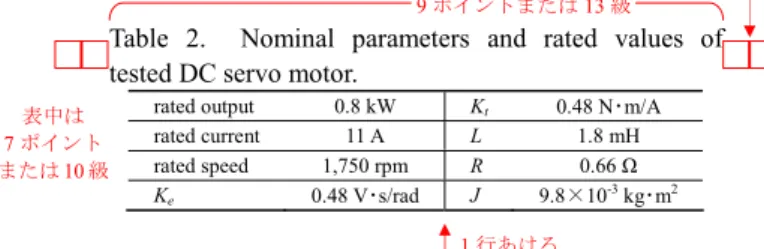
Table 2. Nominal parameters and rated values of tested DC servo motor.
rated output 0.8 kW Kt 0.48 N・m/A
rated current 11 A L 1.8 mH
rated speed 1,750 rpm R 0.66 Ω Ke 0.48 V・s/rad J 9.8×10⁻³ kg・m2